

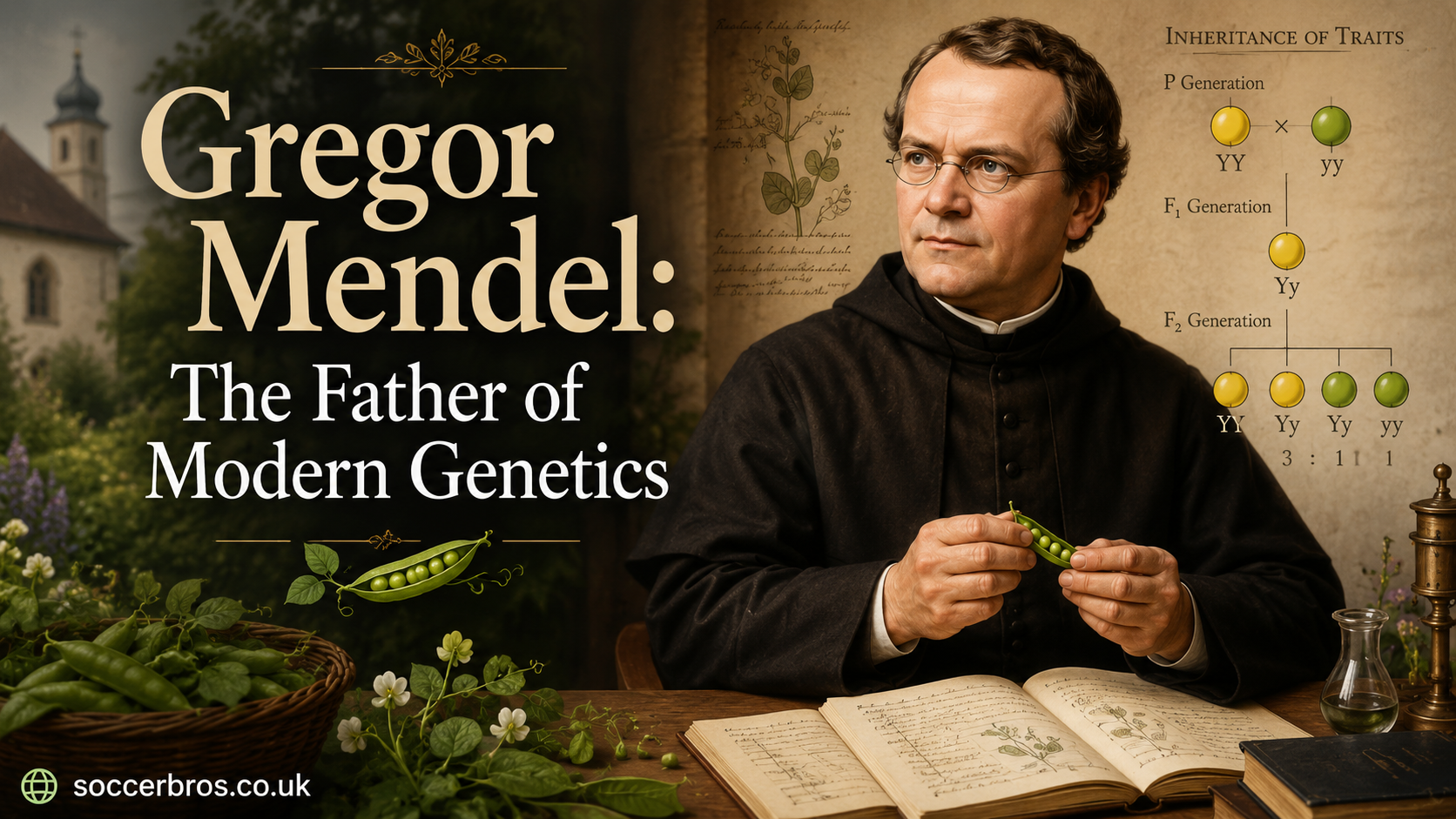

Gregor Mendel: The Father of Modern Genetics
The Quiet Monk Who Changed Biology Forever
Some people change history with loud speeches, bold inventions, or dramatic discoveries. Others do it quietly, almost invisibly, while working in a garden. Gregor Mendel belonged to the second group. He was not a famous celebrity in his own lifetime. He was not celebrated by large scientific institutions while he was alive. In fact, for many years, his work sat almost unnoticed.
- Gregor Mendel: The Father of Modern Genetics
- The Quiet Monk Who Changed Biology Forever
- Gregor Mendel Bio Table
- Who Was Gregor Mendel?
- Why Is Gregor Mendel Called the Father of Modern Genetics?
- Gregor Mendel’s Early Life and Education
- Why Did Gregor Mendel Choose Pea Plants?
- Gregor Mendel’s Pea Plant Experiments Explained Simply
- The Three Major Laws Linked to Gregor Mendel
- Why Gregor Mendel’s Work Was Ignored at First
- The Rediscovery of Gregor Mendel’s Work
- How Gregor Mendel Changed Science
- Gregor Mendel and the Power of Observation
- Common Misunderstandings About Gregor Mendel
- Gregor Mendel Personality and Character
- Why Gregor Mendel Still Matters Today
- A Simple Example of Mendelian Inheritance
- Gregor Mendel Legacy in Education
- How Gregor Mendel Built Trust Through Method
- Timeline of Gregor Mendel’s Life and Work
- Interesting Facts About Gregor Mendel
- Why Mendel Story Feels So Modern
- Conclusion: Gregor Mendel Lasting Gift to the World
Yet today, Gregor Mendel is remembered as one of the most important figures in science. His simple but brilliant experiments with pea plants helped explain how traits pass from parents to offspring. In other words, he helped unlock the basic rules of heredity.
That is why Gregor Mendel is often called the Father of Modern Genetics.
What makes his story even more fascinating is how ordinary it first appears. A monk, a monastery garden, pea plants, careful notes, and patience. That was the setting. But behind those rows of plants was a mind asking one of biology’s biggest questions: why do living things look the way they do?
Before Mendel, people had many ideas about inheritance, but most were vague. Some believed traits simply blended together, like mixing paint. If one parent had tall traits and another had short traits, the child would somehow become medium. It sounded reasonable, but it did not explain many real-life patterns. Mendel noticed that nature worked in a more organized way.
His work became the foundation for genetics, DNA studies, plant breeding, medical research, and even modern biotechnology. Every time we talk about dominant genes, recessive traits, inherited diseases, family resemblance, chromosomes, or genetic variation, we are walking on a path that Mendel helped clear.
Gregor Mendel Bio Table
| Bio Detail | Information |
|---|---|
| Full Name | Johann Gregor Mendel |
| Date of Birth | July 20, 1822 |
| Age | Died at age 61 |
| Profession | Scientist, Augustinian friar, teacher, botanist |
| Nationality | Austrian |
| Net Worth (approx.) | Not publicly recorded; he lived as a monk and scholar |
| Notable Works / Achievements | Founder of modern genetics, pea plant experiments, laws of inheritance |
Who Was Gregor Mendel?
Gregor Mendel was an Austrian monk and scientist born in 1822 in a small village that is now part of the Czech Republic. His birth name was Johann Mendel. Later, when he joined the Augustinian monastery in Brno, he took the name Gregor.
From a young age, Mendel showed a strong interest in nature, farming, and learning. His family lived in a rural area, so he was familiar with plants, crops, and the natural world. This early connection with agriculture may have helped shape his later interest in plant heredity.
However, his path was not easy. His family did not have great wealth, and education was a serious challenge. Still, Mendel had a sharp mind and a deep hunger for knowledge. He studied philosophy, physics, mathematics, and natural science. These subjects later helped him design experiments in a careful and almost mathematical way.
This is one reason Gregor Mendel stands out from many thinkers of his time. He did not simply observe plants and make guesses. He counted results. He tracked patterns. He compared generations. He used numbers to understand biology.
That careful method gave his work lasting strength.
Why Is Gregor Mendel Called the Father of Modern Genetics?
The title “Father of Modern Genetics” is not just a nice phrase. It fits because Gregor Mendel discovered the basic rules that explain how traits are inherited.
Before Mendel, heredity was confusing. Farmers and breeders knew that traits could pass from parents to offspring. They saw that strong animals often produced strong young, and certain plants passed on useful features. However, they did not fully understand the pattern behind it.
Mendel changed that.
Through years of pea plant experiments, he showed that traits are controlled by separate units. Today, we call these units genes. He also showed that some traits can appear in one generation, disappear in the next, and then return later. This idea was surprising at the time.
Mendel’s work introduced the idea that inheritance follows rules, not random mixing. That insight became the base of modern genetics.
The Big Idea Behind Mendel’s Work
At the heart of Mendel’s discovery was a simple but powerful idea: traits are passed through distinct factors from parents to offspring.
Today, those “factors” are known as genes. Genes carry information that affects traits such as eye color, plant height, flower color, seed shape, and many other features.
Mendel did not know about DNA. He did not have microscopes powerful enough to see chromosomes clearly. He did not know the molecular structure of genetic material. Yet his conclusions were so strong that later science confirmed them.
That is the beauty of Gregor Mendel’s work. He found deep biological truth with simple tools and extraordinary patience.
Gregor Mendel’s Early Life and Education
Gregor Mendel was born into a farming family. His parents worked hard, and young Mendel grew up around orchards, fields, and gardens. This background gave him a practical understanding of plants long before he became a scientist.
As a student, Mendel was bright but often struggled financially. His education required sacrifice. At times, illness and poverty interrupted his studies. Still, he continued because he had a natural love for learning.
Later, he entered the Augustinian Abbey of St. Thomas in Brno. This monastery was not just a religious home. It was also a place of learning, discussion, and intellectual activity. Many monks there were involved in teaching, science, and culture.
For Mendel, the monastery gave him access to books, education, and a garden where he could experiment. It also gave him the time and structure needed for long-term research.
Why the Monastery Garden Mattered
It may sound strange today, but the monastery garden was one of the most important scientific spaces of the nineteenth century. This was where Gregor Mendel carried out his famous pea plant experiments.
The garden allowed him to grow thousands of plants under controlled conditions. He could select parent plants, cross-pollinate them, protect them from unwanted pollination, and record the results.
In a way, the garden became his laboratory.
This is an important lesson. Great discoveries do not always require expensive equipment. Sometimes, they require a good question, a clear method, and the patience to keep going.
Why Did Gregor Mendel Choose Pea Plants?
Mendel did not choose pea plants by accident. He selected them because they were ideal for studying inheritance.
Pea plants had clear traits that were easy to observe. For example, some plants were tall while others were short. Some had purple flowers while others had white flowers. Some produced round seeds while others produced wrinkled seeds.
These differences made it easier to track patterns from one generation to the next.
Key Reasons Pea Plants Worked So Well
Mendel chose pea plants because:
- They grew quickly compared to many other plants.
- They produced many offspring.
- Their traits were easy to see and record.
- They could self-pollinate.
- They could also be cross-pollinated by hand.
- They had clear opposite traits, such as tall or short plants.
- They were practical to grow in a garden setting.
Because of these advantages, Gregor Mendel could study heredity with unusual accuracy for his time.
Gregor Mendel’s Pea Plant Experiments Explained Simply
The famous pea plant experiments began with careful selection. Mendel first made sure he had true-breeding plants. A true-breeding plant always produced offspring with the same trait when self-pollinated. For example, a true-breeding tall plant would produce tall offspring.
Then Mendel crossed plants with opposite traits.
For example, he crossed tall pea plants with short pea plants. In the first generation, all the offspring were tall. This seemed to suggest that the tall trait dominated the short trait.
However, the real surprise came in the next generation. When the first-generation plants were allowed to reproduce, short plants appeared again. The short trait had not disappeared. It had been hidden.
This helped Mendel understand the difference between dominant and recessive traits.
Dominant and Recessive Traits
A dominant trait is one that appears when at least one copy of its genetic factor is present. A recessive trait appears only when two copies of the recessive factor are present.
In Mendel’s pea plants, tallness was dominant over shortness. Purple flower color was dominant over white flower color. Round seeds were dominant over wrinkled seeds.
This idea is now a basic part of biology education. Students around the world learn about dominant and recessive genes because of Gregor Mendel.
The Three Major Laws Linked to Gregor Mendel
Mendel’s work led to several important principles of inheritance. These are often called Mendel’s laws.
1. Law of Dominance
The law of dominance explains that when two different forms of a trait are present, one may hide the other. The visible trait is called dominant, while the hidden one is called recessive.
For example, if a pea plant has one factor for tallness and one for shortness, it may grow tall because tallness is dominant.
This law helped explain why some traits show up while others seem to vanish for a generation.
2. Law of Segregation
The law of segregation states that each organism carries two factors for a trait, but these factors separate during reproduction. Each parent passes only one factor to its offspring.
This was a major breakthrough. It explained why recessive traits can return in later generations.
In simple words, offspring receive one genetic factor from each parent. The combination they receive affects the trait they show.
3. Law of Independent Assortment
The law of independent assortment explains that different traits can be inherited separately from one another.
For example, seed shape and flower color may be passed down independently. A plant can inherit round seeds without necessarily inheriting a certain flower color.
This principle helped scientists understand genetic variation. It also explained why offspring can show many different combinations of traits.
Why Gregor Mendel’s Work Was Ignored at First
One of the most surprising parts of the Gregor Mendel story is that his work was not widely appreciated during his lifetime.
He presented his findings in the 1860s, but most scientists did not understand their importance. There were several reasons for this.
First, biology at the time was not ready for his mathematical approach. Mendel used numbers and ratios, which were unusual in plant studies then. Many naturalists preferred description over statistics.
Second, his paper was published in a relatively limited scientific setting. It did not spread quickly to the wider scientific world.
Third, the concept of genes did not yet exist in the modern sense. Without knowledge of chromosomes and DNA, many scientists could not see how powerful Mendel’s findings were.
As a result, Gregor Mendel died without knowing how famous his work would become.
The Rediscovery of Gregor Mendel’s Work
Around 1900, several scientists studying heredity came across Mendel’s research. By that time, biology had advanced, and scientists were better prepared to understand his ideas.
Once his work was rediscovered, its value became clear. Researchers realized that Mendel had already explained core patterns of inheritance decades earlier.
This rediscovery helped launch genetics as a modern scientific field.
Suddenly, Gregor Mendel was no longer a forgotten monk with garden notes. He became a central figure in biology.
How Gregor Mendel Changed Science
The impact of Gregor Mendel reaches far beyond pea plants. His ideas shaped many areas of science and life.
Modern Genetics
Genetics is the study of genes, heredity, and variation. Mendel’s work gave this field its first real structure. Without his laws of inheritance, modern genetics would have developed much more slowly.
Today, genetics helps explain inherited traits, genetic disorders, family history, and biological diversity.
Agriculture and Plant Breeding
Farmers and plant breeders use genetic principles to develop better crops. They may select for disease resistance, stronger growth, better yield, improved taste, or climate tolerance.
Mendel’s ideas helped make breeding more scientific. Instead of relying only on guesswork, breeders could study patterns and predict outcomes more effectively.
Medicine and Human Health
Modern medicine uses genetics in many ways. Doctors and researchers study inherited diseases, genetic risk factors, and family health patterns.
Although human genetics is more complex than pea plant inheritance, Mendel’s basic principles still matter. They help explain conditions linked to single genes, such as certain inherited disorders.
Evolution and Biodiversity
Genetics also supports the study of evolution. Variation within populations is essential for natural selection. Mendel’s work helped explain how traits are preserved, hidden, and passed on.
In addition, genetics helps scientists study species relationships, adaptation, and biodiversity.
Gregor Mendel and the Power of Observation
One of the most inspiring things about Gregor Mendel is his patience. He did not rush to conclusions. He watched, counted, compared, and repeated his experiments.
This matters because science is not only about having a bright idea. It is also about testing that idea carefully.
Mendel worked with thousands of plants. He tracked traits over generations. He paid attention to details that others may have ignored.
That is why his work still feels modern. His methods were clean, organized, and honest.
What Writers, Students, and Thinkers Can Learn from Mendel
Mendel’s story is useful even outside science. It teaches several life lessons:
- Small experiments can lead to big discoveries.
- Careful work often wins over quick guesses.
- Being ignored does not mean being wrong.
- Patience can create lasting impact.
- Simple questions can open huge doors.
- Real expertise comes from deep attention.
- Trustworthy work stands the test of time.
In a noisy world, Gregor Mendel reminds us that quiet discipline still matters.
Common Misunderstandings About Gregor Mendel
Because Mendel is so famous today, people sometimes simplify his story too much. Let’s clear up a few common misunderstandings.
Mendel Did Not Discover DNA
Gregor Mendel did not discover DNA. The structure of DNA was discovered much later. However, Mendel discovered the inheritance patterns that DNA helps explain.
He understood that traits were passed through separate units, even though he did not know what those units physically were.
Mendel’s Work Was Not Luck
Some people imagine Mendel simply got lucky with pea plants. While pea plants were a good choice, his success came from careful planning. He selected traits wisely, controlled pollination, and used clear numbers.
His results were not random garden observations. They were the product of disciplined scientific work.
Mendel’s Laws Do Not Explain Every Trait
Not all traits follow simple Mendelian patterns. Many human traits involve multiple genes, environmental influence, or complex inheritance. Height, skin tone, intelligence, and many health conditions are shaped by many factors.
However, Mendel’s laws remain a foundation. They explain basic inheritance and help students understand more complex genetics later.
Gregor Mendel Personality and Character
When we think of scientific legends, we often picture dramatic personalities. But Gregor Mendel seems to have been more reserved, thoughtful, and steady.
He worked as a teacher, monk, and later an abbot. His life was filled with religious duties, education, administration, and study. He was not a full-time scientist in the modern professional sense, yet he produced work that changed the world.
That makes his story even more powerful. He did not need fame to do meaningful work. He needed curiosity, structure, and commitment.
A Human Side to Mendel
It is easy to turn historical figures into statues. But Mendel was a real person. He had setbacks. He faced academic pressure. He struggled with exams at points in his teaching career. He also lived in a time when scientific communication was slower and more limited than today.
Still, he kept learning. He kept testing. He kept recording.
That human side makes Gregor Mendel more relatable. His greatness was not magic. It came from persistence.
Why Gregor Mendel Still Matters Today
More than a century after his death, Gregor Mendel still matters because genetics touches almost every part of modern life.
When people talk about inherited traits, family resemblance, genetic testing, ancestry, crop improvement, medical research, or DNA, they are connected to Mendel’s legacy.
His work also matters in classrooms. Students often meet Mendel early in biology because his experiments offer a simple doorway into a complex subject.
Genetics in Everyday Life
You do not have to be a scientist to see genetics around you. It appears in everyday questions like:
- Why do children resemble their parents?
- Why do siblings look different from each other?
- Why do some diseases run in families?
- Why do certain plants produce better fruit?
- Why do breeders choose specific traits in animals?
- Why can a hidden trait appear after generations?
These questions all connect back to inheritance. And inheritance, in modern biology, begins with Gregor Mendel.
A Simple Example of Mendelian Inheritance
Imagine two pea plants. One carries a dominant trait for purple flowers, and the other carries a recessive trait for white flowers. If the offspring receives at least one dominant factor, it may show purple flowers. But if it receives two recessive factors, it may show white flowers.
This simple model helps explain why traits can skip a generation. A trait may be hidden in carriers and appear later when the right combination returns.
Of course, real genetics can become much more complex. Still, Mendel’s basic model gives learners a strong starting point.
Gregor Mendel Legacy in Education
Teachers still use Gregor Mendel because his experiments are easy to understand and deeply meaningful. Pea plants, traits, ratios, and family patterns help students see how science works.
Mendel’s work also introduces important scientific habits:
- Asking clear questions
- Designing fair experiments
- Recording data
- Looking for patterns
- Testing ideas
- Avoiding assumptions
- Explaining results with evidence
These habits are useful in every field, not just biology.
How Gregor Mendel Built Trust Through Method
E-E-A-T matters in modern content, but the principle is also visible in Mendel’s science. His work showed experience because he spent years growing and observing plants. It showed expertise because he understood mathematics and biology. It showed authority because later research confirmed his findings. It showed trustworthiness because his data followed a clear and testable method.
That is why Gregor Mendel remains respected. His conclusions were not built on opinion. They were built on evidence.
Timeline of Gregor Mendel’s Life and Work
| Year | Event |
|---|---|
| 1822 | Gregor Mendel was born as Johann Mendel |
| 1843 | He entered the Augustinian monastery in Brno |
| 1850s | He studied science and developed strong research interests |
| 1856 | He began his famous pea plant experiments |
| 1865 | He presented his findings on plant hybridization |
| 1866 | His research paper was published |
| 1884 | Gregor Mendel died |
| 1900 | His work was rediscovered by scientists |
| 20th century | Mendel became known as the Father of Modern Genetics |
Interesting Facts About Gregor Mendel
Here are a few facts that make Gregor Mendel even more interesting:
- He studied pea plants for around eight years.
- He worked with thousands of plants.
- He was trained in both science and mathematics.
- His research was ignored for decades.
- He became an abbot later in life.
- He did not know about DNA, yet his work predicted genetic behavior.
- His monastery garden became one of the most famous gardens in science history.
- His ideas shaped biology, medicine, farming, and evolution studies.
- He is now taught in schools around the world.
- His discoveries remain a foundation of genetics.
Why Mendel Story Feels So Modern
There is something surprisingly modern about Gregor Mendel. He gathered data. He looked for patterns. He questioned popular beliefs. He used evidence instead of guesswork. That sounds exactly like good science today.
Moreover, his story fits the modern idea that innovation can come from unexpected places. A world-changing discovery does not always begin in a famous laboratory. Sometimes it begins in a quiet garden with a curious mind.
That is why Mendel’s story still feels fresh. It is not only about peas and genes. It is about seeing order where others see confusion.
Conclusion: Gregor Mendel Lasting Gift to the World
Gregor Mendel may have lived a quiet life, but his impact was enormous. Through careful pea plant experiments, he discovered patterns of inheritance that changed biology forever. His ideas helped build the science of genetics, influenced agriculture, supported medical research, and gave us a clearer view of how life passes traits from one generation to the next.
He did not have modern labs. He did not know about DNA. He did not become famous while he was alive. However, his patient work proved that truth can survive silence. Years after his death, the world finally understood what he had found.
Today, Gregor Mendel stands as a symbol of curiosity, discipline, and scientific trust. His story reminds us that even small questions can lead to giant answers.
If you found this guide helpful, share it with someone who enjoys science, history, or inspiring stories of people who changed the world quietly but powerfully.