


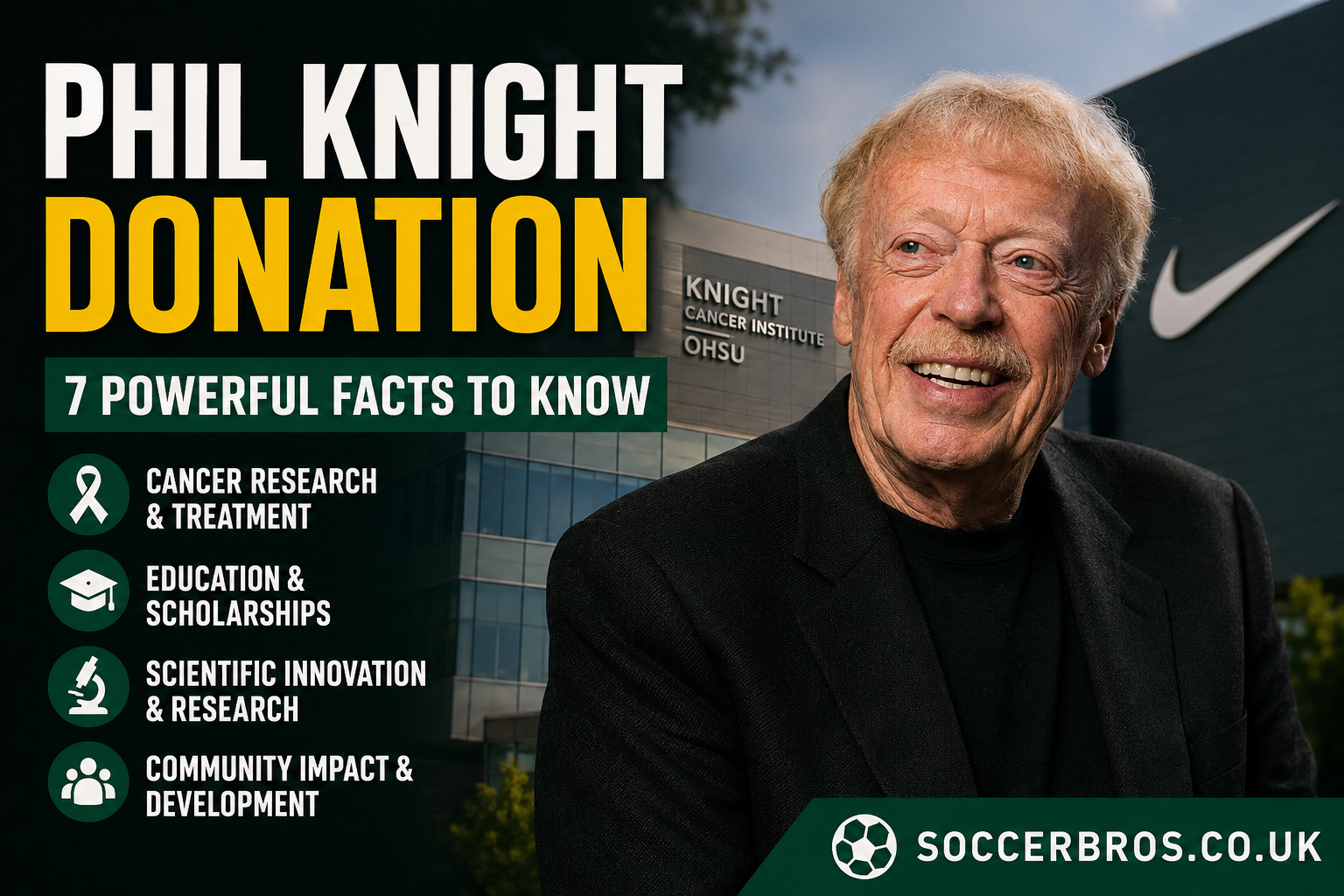

Phil Knight Donation: 7 Powerful Facts to Know
When most people hear the name Phil Knight, they picture running shoes, the Nike Swoosh, and one of the biggest business success stories in modern history. Yet there is another side to his legacy that deserves just as much attention: his extraordinary record of charitable giving.
- Phil Knight Donation: 7 Powerful Facts to Know
- 2. Knight Had Already Helped Build a $1 Billion Cancer Campaign
The Phil Knight Donation story is not built around one cheque or one institution. It stretches across cancer treatment, medical research, graduate scholarships, scientific discovery, university facilities, local communities, and economic development. Together with his wife, Penny Knight, the Nike co-founder has directed billions of dollars toward projects designed to operate for decades.
Some gifts have funded buildings. Others have supported researchers, students, doctors, and emerging leaders. A few have used matching challenges to encourage thousands of other donors to take part. That combination makes Knight’s philanthropic strategy especially interesting.
His approach is ambitious, personal, and closely connected to Oregon, the state where he grew up and built Nike. However, his support has also reached Stanford University and students from around the world.
Here are seven powerful facts that explain the scale, purpose, and lasting importance of the Phil Knight Donation legacy.
Phil Knight Biography
| Detail | Information |
|---|---|
| Full Name | Philip Hampson Knight |
| Date of Birth | February 24, 1938 |
| Age | 88 years old as of 2026 |
| Profession | Businessman, investor, author, and philanthropist |
| Nationality | American |
| Net Worth (Approx.) | About $24.6 billion as of June 2026, although estimates change with Nike’s share value |
| Notable Works / Achievements | Co-founder and chairman emeritus of Nike, author of Shoe Dog, major supporter of cancer research, higher education, science, and community development |
Who Is Phil Knight?
Phil Knight is an American entrepreneur best known as the co-founder of Nike. He helped build the company from a small running-shoe business into a global sportswear brand.
Before Nike became a household name, Knight was a runner at the University of Oregon. There, he trained under Bill Bowerman, the respected track coach who later became his business partner. Knight then earned an MBA from Stanford Graduate School of Business.
That personal journey matters because many of his largest donations have gone back to the institutions and communities that shaped his life. The University of Oregon strengthened his connection to athletics and leadership. Stanford helped develop his business thinking. Oregon later became the center of Nike’s worldwide growth.
Today, Knight holds the position of chairman emeritus at Nike. He is also known for his memoir, Shoe Dog, which describes the setbacks, risks, financial pressures, and unexpected breakthroughs behind the company.
However, the Phil Knight Donation record shows that his influence extends well beyond footwear and sport.
A Quick Look at Phil Knight’s Major Donations
| Area of Support | Major Commitment | Intended Impact |
|---|---|---|
| OHSU Knight Cancer Institute | $2 billion announced in 2025 | Cancer care, research, prevention, treatment, and innovation |
| Earlier OHSU Cancer Challenge | $500 million matching gift | Helped create a $1 billion fundraising campaign |
| University of Oregon Knight Campus | Two $500 million gifts | Scientific research, biomedical innovation, and education |
| Knight-Hennessy Scholars at Stanford | $400 million | Graduate scholarships and leadership development |
| 1803 Fund in Portland | $400 million | Education, culture, community prosperity, and redevelopment |
| Stanford Graduate School of Business | $105 million | Helped fund the Knight Management Center |
These are not the only examples of Knight’s philanthropy. Still, they reveal a clear pattern: he tends to support large, long-term projects with the ability to reshape an entire institution or field.
1. The $2 Billion Cancer Commitment Was Historic
The most striking recent Phil Knight Donation was the $2 billion commitment made by Phil and Penny Knight to the OHSU Knight Cancer Institute in August 2025.
Oregon Health & Science University described it as the largest single donation ever announced for a United States university, college, or academic health center at that time. That alone made headlines, but the purpose behind the gift was even more significant.
The money was intended to transform cancer care and create a stronger system connecting:
- Cancer prevention
- Early detection
- Laboratory research
- Clinical trials
- Patient treatment
- Specialist recruitment
- Advanced technology
- New therapies
- Long-term recovery support
Cancer research often moves slowly because a discovery in a laboratory does not immediately become a treatment available to patients. It may require years of testing, regulation, clinical development, and investment.
A gift of this size can help reduce some of those barriers. It gives an academic health center more freedom to recruit expert scientists, expand research programs, improve facilities, and pursue ideas that may be too expensive or uncertain for traditional funding.
Why This Donation Matters
The commitment was not simply about making an existing hospital larger. Its broader aim was to create a cancer-care model in which researchers and physicians work more closely together.
That can help medical discoveries move from the laboratory to the clinic more efficiently. For patients, this may eventually mean earlier diagnoses, more targeted treatments, and better access to specialists.
The Phil Knight Donation therefore represents more than financial generosity. It is a large-scale investment in the future of public health.
2. Knight Had Already Helped Build a $1 Billion Cancer Campaign
The 2025 commitment did not appear from nowhere. It built on years of support for OHSU and the Knight Cancer Institute.
In 2008, Phil and Penny Knight gave $100 million to the institute. Then, in 2013, they proposed a bold challenge: they would contribute another $500 million if OHSU could raise an equal amount from other donors.
The university accepted the challenge. In less than two years, supporters contributed the required $500 million, creating a combined $1 billion campaign.
This matching-grant strategy was powerful for several reasons.
First, it gave donors a clear deadline and a shared goal. Second, it made individual contributions feel more valuable because every dollar helped unlock the Knights’ matching gift. Finally, it turned one family’s promise into a broad community fundraising effort.
Instead of acting as the only benefactors, Phil and Penny Knight encouraged other individuals, foundations, companies, and supporters to participate.
A Donation That Encouraged More Donations
This approach is often called catalytic philanthropy. A catalytic gift does not merely fund a project directly. It motivates additional investment, attracts public attention, and builds momentum around a cause.
The Knight Cancer Challenge became a strong example of how one major donor can inspire thousands of other people to act.
The campaign focused heavily on the early detection of lethal cancers. This remains one of the greatest challenges in medicine because several dangerous cancers may not cause obvious symptoms until they have already spread.
By supporting detection research, scientific teams can study biomarkers, imaging methods, genetics, data analysis, and other tools that may identify disease sooner.
This earlier Phil Knight Donation laid important groundwork for the much larger cancer commitment announced in 2025.
3. Two $500 Million Gifts Transformed Science at Oregon
Phil Knight’s connection with the University of Oregon is deeply personal. He studied there, ran on its track team, and met Bill Bowerman, the coach who later became his Nike co-founder.
In 2016, Phil and Penny Knight gave the university $500 million to establish the Phil and Penny Knight Campus for Accelerating Scientific Impact.
Five years later, in 2021, they announced a second $500 million gift.
Together, the two commitments provided $1 billion for the research campus.
The Knight Campus was created to speed up scientific discovery and turn academic research into practical solutions. Its work connects several fields, including:
- Bioengineering
- Biomedical science
- Medical devices
- Data science
- Materials research
- Regenerative medicine
- Entrepreneurship
- Product development
- Graduate education
- Commercial innovation
Traditional university departments sometimes operate separately from one another. A biologist may have limited contact with an engineer, business expert, or product designer. The Knight Campus aims to bring those skills together.
That matters because many important inventions appear at the intersection of different disciplines.
From Scientific Idea to Real-World Product
A promising scientific discovery is only the beginning. To improve lives, that discovery may need to become a medical device, diagnostic test, therapy, commercial product, or new company.
The Knight Campus supports the entire innovation pathway. Researchers can test ideas, work with industry partners, develop prototypes, and prepare inventions for real-world use.
Moreover, the campus can attract new faculty members, graduate students, entrepreneurs, and biotechnology companies to Oregon. That may contribute to job creation and regional economic development as well as academic research.
The Phil Knight Donation to the University of Oregon was therefore designed to do more than build impressive laboratories. Its wider purpose was to create a lasting innovation ecosystem.
4. A $400 Million Gift Helped Launch Knight-Hennessy Scholars
In 2016, Phil Knight contributed $400 million to help establish Knight-Hennessy Scholars at Stanford University.
The graduate scholarship program was named after Knight and former Stanford president John Hennessy. It brings students from different countries and academic fields together at Stanford.
Scholars can study across the university’s graduate schools while also taking part in leadership development, community projects, and multidisciplinary learning.
The program aims to prepare talented students to address complicated global problems. These may include:
- Climate change
- Public health
- Education inequality
- Poverty
- Technology policy
- Government leadership
- Scientific ethics
- Sustainable development
- International cooperation
- Social innovation
Many scholarships focus mainly on tuition. Knight-Hennessy goes further by building a community of students from different professional and cultural backgrounds.
A medical student may exchange ideas with an engineer. A lawyer may work with an environmental scientist. A business student may learn from someone studying public policy.
Investing in People Rather Than One Predicted Outcome
This Phil Knight Donation reflects a different form of philanthropy. Cancer research and science campuses often have clear physical results, such as laboratories, treatments, or technologies.
A leadership scholarship is less predictable. The donor cannot know exactly what each scholar will accomplish 10, 20, or 30 years later.
That uncertainty is part of the idea. By supporting capable people rather than a single predetermined project, the program creates many possible paths toward public impact.
Some graduates may start companies. Others may enter medicine, education, government, scientific research, or nonprofit leadership. Their influence could spread across numerous countries and industries.
5. The Knights Committed $400 Million to Portland’s 1803 Fund
Although universities and medical institutions receive much of the attention, the Knight family’s giving has also extended into community development.
In 2023, Phil and Penny Knight committed $400 million to the 1803 Fund. The initiative focuses on Portland’s historically Black communities, particularly areas connected to the Albina neighborhood.
Over several decades, parts of Albina experienced displacement and disruption caused by urban renewal, highway construction, and major development projects. Homes, businesses, and community spaces were lost.
The 1803 Fund was created to support areas such as:
- Education
- Housing and development
- Arts and culture
- Youth opportunities
- Community spaces
- Economic prosperity
- Local business growth
- Neighborhood identity
- Culture and belonging
- Long-term place-based investment
This commitment stands apart from a conventional charity grant. It combines elements of philanthropy, community planning, investment, and redevelopment.
Why Place-Based Giving Is Different
Place-based philanthropy concentrates resources on a defined community instead of spreading small grants across many locations.
That focus can make it easier to address connected problems. Education, housing, business growth, cultural preservation, and employment are rarely separate issues. Progress in one area can support progress in another.
For example, a neighborhood project may create construction work, permanent jobs, public spaces, commercial opportunities, and youth programs at the same time.
The 1803 Fund also highlights the importance of local leadership. Large donors provide capital, but community leaders bring knowledge of the neighborhood’s history, needs, and priorities.
Through this commitment, the Phil Knight Donation story moved beyond campuses and hospitals into direct community investment.
6. His Giving Reflects His Personal Life Story
A clear pattern runs through Phil Knight’s major charitable contributions: he frequently gives to places that played an important role in his own life.
The University of Oregon connected him with running, Bill Bowerman, and the early ideas that later shaped Nike. Stanford gave him business training and encouraged the entrepreneurial thinking behind his shoe-company plan. Oregon became his lifelong home and the base from which Nike grew.
This personal connection may explain why his giving often feels highly concentrated rather than widely scattered.
Some philanthropists support hundreds of unrelated causes. Knight’s largest gifts, by contrast, tend to return to a smaller group of institutions and communities.
That focus has advantages. A donor who knows an institution well may better understand its leadership, culture, potential, and limitations. Long-term relationships can also make larger projects possible.
However, concentrated philanthropy can raise reasonable questions about influence and priorities. When a private donor gives billions to a university or healthcare organization, the institution must still protect academic independence, public accountability, patient interests, and responsible governance.
Those questions do not erase the value of the donation. Instead, they show why transparency and oversight remain important whenever private wealth funds public-facing institutions.
Philanthropy as a Form of Gratitude
Knight’s pattern of giving can also be understood as gratitude.
He appears to invest in the institutions that helped him develop as an athlete, student, entrepreneur, and business leader. The result is a philanthropic legacy closely tied to his own biography.
That helps explain why the Phil Knight Donation story is so strongly associated with Oregon and Stanford rather than with a long list of unrelated global causes.
7. Penny Knight Is a Central Partner in the Giving
Headlines often shorten these commitments to “Phil Knight donations.” Yet many of the largest gifts have been made jointly by Phil and his wife, Penny Knight.
That distinction matters.
The $2 billion OHSU commitment, the University of Oregon Knight Campus gifts, the cancer challenge, and the 1803 Fund commitment were associated with both Phil and Penny.
Philanthropy at this level is rarely a one-person activity. Major commitments involve years of planning, financial management, legal work, institutional negotiation, and conversations about long-term purpose.
Penny Knight’s presence also reminds readers that the family’s charitable legacy should not be credited solely to the famous Nike co-founder.
The public may naturally focus on Phil because of his global business profile. Still, the repeated joint announcements show that Penny has played an important role in the family’s philanthropic decisions.
For accurate reporting, it is often better to describe major commitments as gifts from Phil and Penny Knight rather than from Phil alone.
What Makes Phil Knight’s Philanthropic Strategy Different?
Several qualities make the Phil Knight Donation approach stand out.
The Gifts Are Transformational
A transformational gift is large enough to change what an organization believes is possible. It may create a new institute, campus, scholarship program, or research model rather than simply supporting routine expenses.
The Commitments Are Long-Term
Scientific research, cancer treatment, and graduate education do not produce instant results. The Knights’ giving often supports projects intended to grow over several decades.
The Strategy Connects People and Infrastructure
Buildings matter, but they cannot create discoveries on their own. Knight-backed projects also focus on recruiting researchers, educating students, supporting doctors, developing leaders, and building partnerships.
Matching Challenges Expand Participation
The OHSU cancer challenge showed how a major pledge can motivate a much wider donor community. This multiplies the original gift’s fundraising impact.
Local Roots Remain Important
Even though Nike became a global company, much of Knight’s philanthropy remains centered in Oregon. His donations support local research, education, healthcare, neighborhoods, jobs, and economic development.
Is the Phil Knight Donation Larger Than His Net Worth Suggests?
Net-worth estimates can be misleading when discussing billionaires. Much of a wealthy founder’s fortune may be tied to shares, trusts, investments, and other assets rather than cash sitting in a bank account.
Knight’s estimated wealth can also rise or fall when Nike’s stock price changes. Therefore, any net-worth figure should be treated as a temporary estimate, not a fixed amount.
Likewise, a charitable commitment is not always transferred in one immediate payment. Large pledges may be distributed over several years and may include specific conditions or schedules.
Even with those qualifications, the scale of Knight’s charitable giving is remarkable. Commitments measured in hundreds of millions or billions can affect institutional planning, hiring, construction, research, and fundraising for generations.
The Broader Impact of Phil Knight’s Giving
The true effect of philanthropy cannot be measured by donation totals alone.
A billion-dollar announcement is impressive, but the more important questions are practical:
- Does the cancer research lead to earlier detection?
- Do patients receive better treatment?
- Do scholarship recipients become responsible leaders?
- Does scientific work produce useful medical technology?
- Do local residents benefit from community investment?
- Are new jobs and educational opportunities created?
- Are institutions transparent about how funds are used?
These outcomes may take years to evaluate.
That is why the Phil Knight Donation legacy is still developing. Some buildings are already open. Researchers are working. Students are studying. Community projects are moving forward. Yet many of the most important results may not be visible for another decade.
Conclusion
The Phil Knight Donation story reveals a side of the Nike co-founder that is just as significant as his business career. Together with Penny Knight, he has supported cancer research, advanced medical care, scientific innovation, graduate scholarships, university education, leadership development, and community prosperity.
The $2 billion OHSU commitment may be the most dramatic example, but it is part of a much longer pattern. Two $500 million gifts helped create and expand the Knight Campus at the University of Oregon. A $400 million contribution helped launch Knight-Hennessy Scholars at Stanford. Another $400 million commitment gave the 1803 Fund the resources to invest in Portland’s historically Black communities.
Each project is different. Still, the strategy behind them is consistent: choose ambitious institutions, provide long-term capital, and aim for change that continues well beyond the original donation.
Money alone cannot cure cancer, create good leaders, or rebuild a neighborhood. It must be paired with skilled people, responsible management, community trust, and measurable results. Nevertheless, major charitable investment can give those people and institutions the resources to attempt work that once seemed impossible.
That may ultimately be the most important lesson from Phil Knight’s philanthropy. His giving is not simply about writing large cheques. It is about creating platforms on which researchers, students, doctors, entrepreneurs, and communities can build something lasting.
Share this article with anyone interested in philanthropy, Nike’s history, medical innovation, or higher education, and add your thoughts on which Phil Knight Donation could create the greatest long-term impact.